
During my Organisational Relationship Systems Coach (ORSC) training, I was introduced to the concept of Process Work which has fundamentally changed how I think about coaching individuals, relationships, and teams.
While many coaching approaches focus on identifying problems and finding solutions, Process Work invites a different question: What is trying to happen? Rather than forcing change, the coach becomes curious about what is already unfolding to help individuals and teams discover new possibilities.
Read more: Process Work – Listening to What Wants to EmergeWe all have qualities, behaviors, and beliefs that feel familiar. Process Work calls these our primary identities. These are:
- The qualities we consciously identify with
- What feels normal and comfortable
- How we see ourselves
- What others typically recognize in us
But there are also qualities that exist outside our current self-image. These are called secondary identities. They often feel:
- Uncomfortable
- Unknown
- Challenging
- Somewhat foreign
The space between our primary identity and our secondary identity as a dream what could be is called the edge. It is the boundary between what is known and what is possible. Growth often happens at this boundary.
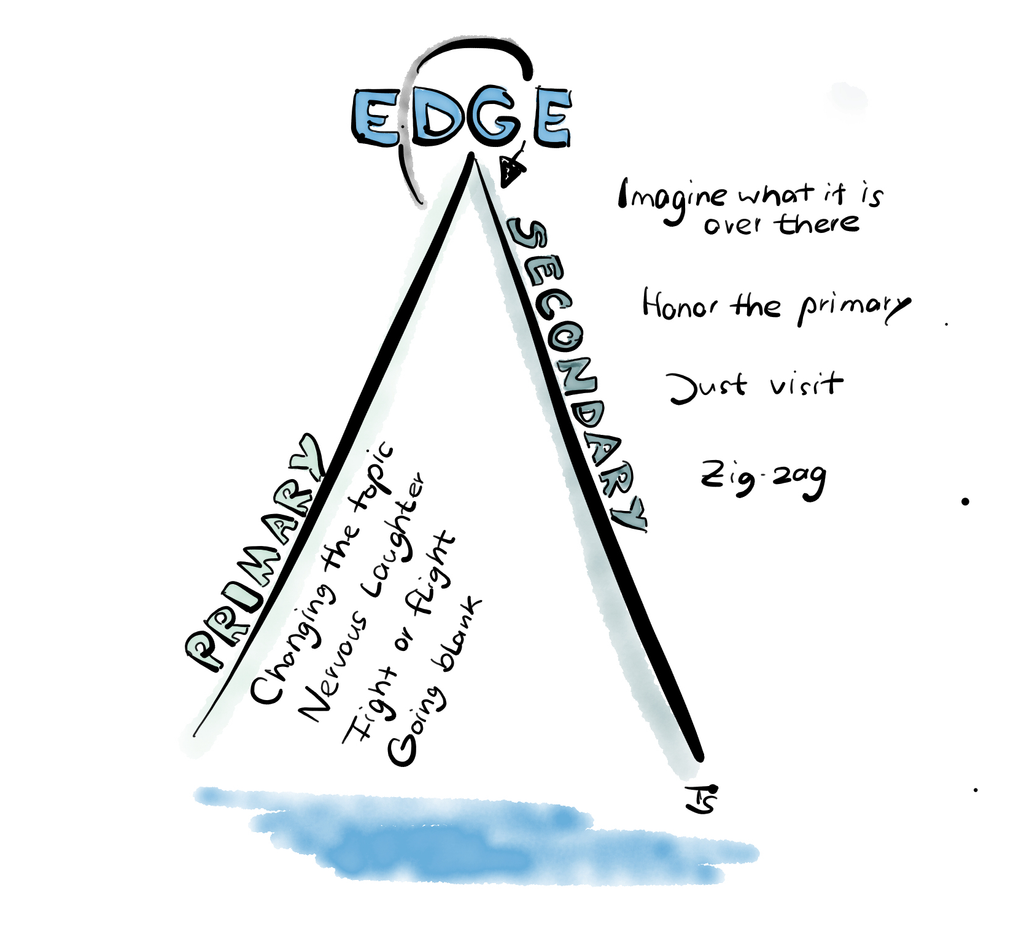
Whenever a team or an individual approaches an edge, the following edge behaviors might show up:
- Withdrawal
- Deflection
- Nervous laughter
- Joking
- Changing the subject
- A sudden drop in energy
They are signals that tell us that something important is trying to emerge. Noticing edge behavior helps a system become aware of itself.
Crossing an edge does not require abandoning our primary identity. Instead, we can use our primary to explore unfamiliar territory of the secondary. Rather than making a dramatic leap, playfully zig-zag between what is familiar and unfamiliar.
Channel Switches
Channels are signals around edges. When we focus only on words, we miss much of the information available to us which might appear through:
- a metaphor
- an awkward silence
- a movement
- a sensation
- an emotional field
- a change in energy
Process Work invites to listen through different channels simultaneously. Not to interpret them but unfold them with curiosity to help the system hear itself.
The Auditory Channel includes:
- Words
- Tone of voice
- Volume
- Rhythm
- Pace
- Silence
Often the information is not contained in the content itself but in how it is expressed. And sometimes a system says more in its silence than in a conversation.
- What do you notice about the words or tone being used right now?
- If this silence could speak, what might it be saying?
The Visual Channel communicates through:
- Metaphors
- Images
- Facial expressions
- Posture
- Eye contact
- Spatial arrangement
Sometimes what we can see reveals dynamics that words mask.
- If this situation were an image or scene, what would it look like?
- What do you notice in how the team is physically arranged?
The Movement Channel includes:
- Gestures
- Physical impulses
- Restlessness
- Stillness
- Changes in posture
- Movement within space
Our bodies often know something before our minds do. Process Work invites us to explore the energy that is seeking expression.
- What happens if you follow that movement?
- What does the system want to do right now?
The Sensation Channel is the language of the body:
- Tightness
- Warmth
- Pressure
- Heaviness
- Expansion
- Relaxation
Valuable insight emerges when we slow down enough to listen to the body’s physical sensations:
- Where do you feel this in your body?
- What does that sensation need?
The World Channel reminds us that no relationship or team exists in isolation. It includes information from:
- Organizational culture
- Market conditions
- Social trends
- Economic changes
- Political events
- The physical environment
Sometimes what looks like an internal problem is actually a response to a larger system.
- What larger forces are influencing this system right now?
- How is the outside world showing up inside the team?
The Relationship Channel asks us to focus less on individuals and more on what is happening between them.
- Interaction patterns
- Alliances
- Conflict
- Emotional fields
- Roles
- Polarities
- Ghost roles
It often uncover dynamics that no individual alone can see.
- What role do you notice yourself taking in this relationship?
- If the relationship itself could speak, what would it say?
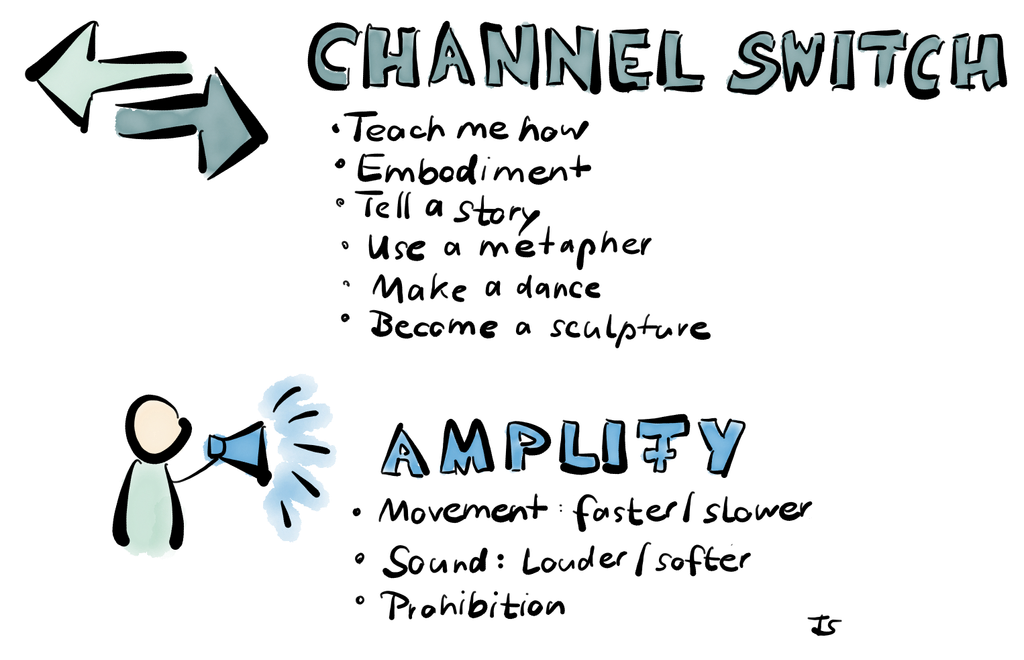
When a system is stuck in one way of communicating, a coach can amplify the current channel or switch to another to access to new information. Switching channels helps us access information that rational conversation misses.
From Verbal → Emotional
when the content is clear but energy is flat.
- What emotion is present for you right now as you say this?
- If this situation had a feeling, what would it be?
- What’s the unspoken feeling in the room?
- What emotion is hardest to name here?
From Verbal → Somatic (Body)
when people talk about issues but feel disconnected.
- Where do you feel this in your body?
- What happens in your body when this comes up?
- If your body could speak, what would it say right now?
- What posture does this issue want you to take?
From Individual → Relational (System)
when there is blame or ownership is too individual.
- What is happening between you right now?
- What does this dynamic need from each of you?
- If this relationship could speak, what would it ask for?
- What role is each of you playing in this pattern?
From Literal → Metaphor (Image)
when people are stuck in explanations.
- If this situation were an image, what would it look like?
- What kind of weather is this relationship right now?
- If this team were a vehicle, what kind would it be?
- What metaphor best describes what’s happening?
From Story → Meaning (Meta Level)
when the system is looping.
- What’s the bigger pattern here?
- What does this situation want you to learn?
- What keeps this dynamic in place?
- What is trying to emerge?
Crossing the Edge
Recently, I explored this concept with a coachee who was struggling to stay focused on important tasks without getting distracted. First we explored her primary identity which she called the juggler. The role represented her ability to easily switch between parenting, leadership, and countless daily demands. I supported her to appreciate and fully embody the Juggler.
- How does the Juggler stand?
- How does she breathe?
- How does she move through the world?
- What do you love about being the Juggler?
- What strengths does she bring?
- What does she make possible?
Process Work encourages us to explore not only the gifts of the Primary but also its costs.
- What does it cost you to keep all the balls in the air?
- What do you sacrifice?
- What part of yourself gets less attention?
- What are you tired of?
The advantages of adaptability remained clear which comes with the costs of mental overload. As we continued exploring, another secondary quality she called Focus began to emerge. It was not something completely foreign, but it felt slightly uncomfortable. When I invited her to embody Focus, the differences were striking. Her movements became slower, her posture became more stable and the energy in the room shifted.
- What do you know that the Juggler doesn’t know?
- What matters most to you?
- What permission do you have that the Juggler doesn’t?
To cross the edge with the Juggler standing in one location and Focus in another, I invited her to create a dialogue between the parts using the following questions:
- What do you appreciate about the other?
- What do you need from the other?
- What wisdom does the other bring?
This approach shifted the dynamic. Instead of being opponents, the two identities began to see themselves as partners. I invited her into a third position which represented neither the Juggler nor Focus and asked her to the following questions:
- If these two parts became partners rather than opponents, what would that partnership look like?
- How would you lead your team?
- How would you decide who gets attention?
The coachee discovered that focus is not the opposite of adaptability. The Juggler did not need to disappear. Focus simply became another resource available to her. There was a shift from: “I have to juggle everything.” to: “I can consciously choose what deserves my attention right now.”
For me the central lesson of Process Work is that a system is constantly communicating. My job as a coach is to help unfold signals so that the system can hear itself well enough to decide what comes next.